
Elementor vs HTML Code: Which Website Creation Is Truly Better in 2026?
Elementor vs HTML Code: Which is Better for Website Creation ?,Choosing how to build a website today is no longer a technical decision alone—it’s a business strategy.
Two popular paths dominate the conversation: Elementor (visual page builder) and custom HTML coding.
But which one is actually better for your website?
This blog goes beyond generic comparisons and breaks down the real-world advantages, limitations, and use cases of both—so you can make a confident decision.
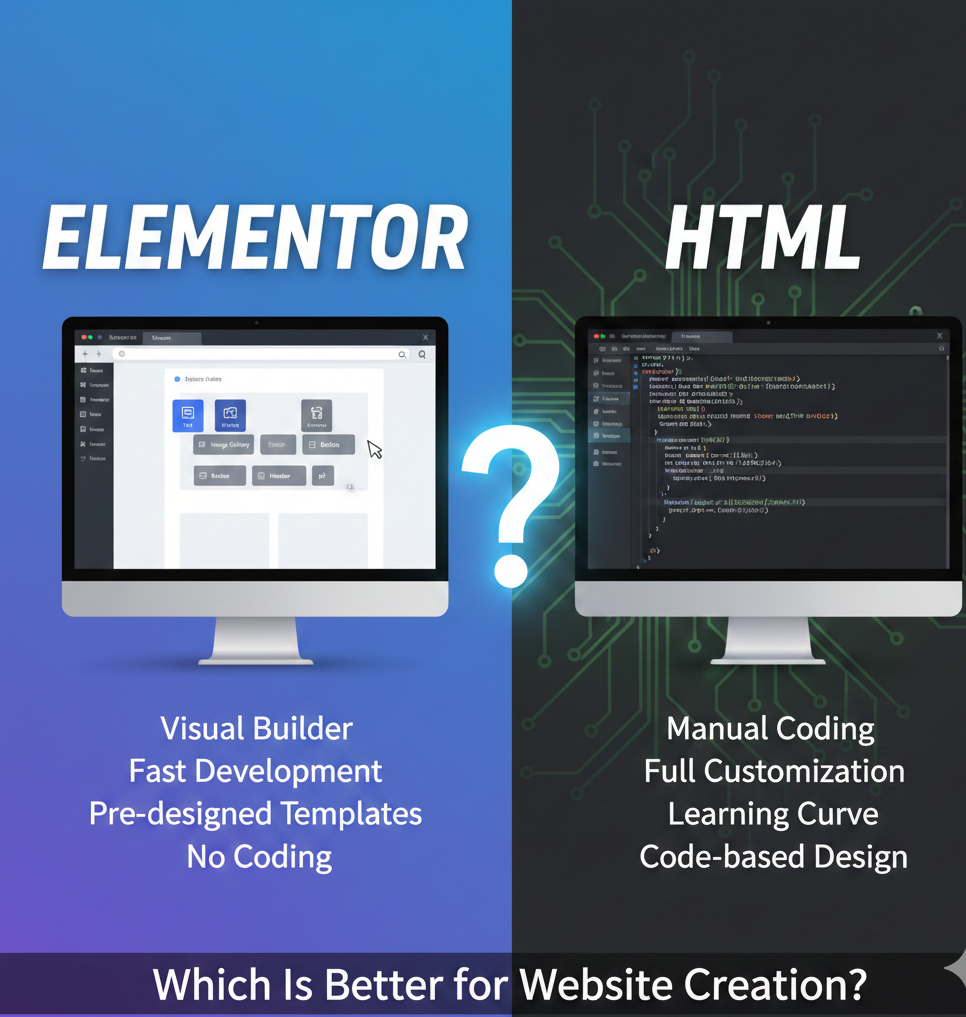
Elementor vs HTML: Which Is Better for Website Creation
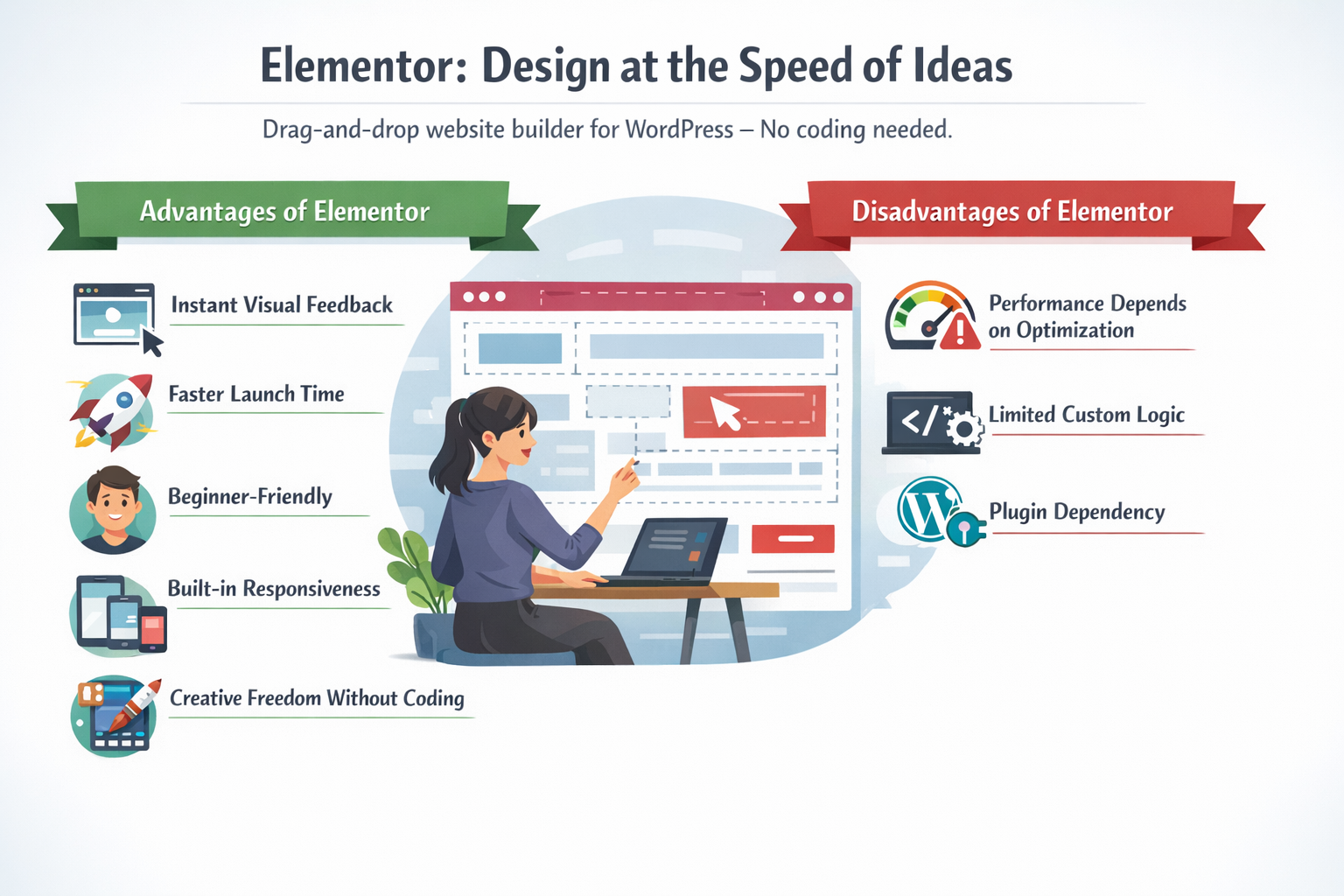
Elementor: Design at the Speed of Ideas
Elementor is a drag-and-drop website builder that allows anyone to visually design pages inside WordPress—without writing code.
Advantages of Elementor
- Instant Visual Feedback
You see your website exactly as visitors will see it—while building it. - Faster Launch Time
Websites that take weeks with code can be launched in days. - Beginner-Friendly
Ideal for entrepreneurs, bloggers, homemakers, and small business owners. - Built-in Responsiveness
Mobile, tablet, and desktop layouts can be adjusted easily. - Creative Freedom Without Coding
Animations, forms, sliders, and popups—no developer required.
Disadvantages of Elementor
- Performance Depends on Optimization
Without proper optimization, pages can load slower. - Limited Custom Logic
Advanced functionality still needs coding support. - Plugin Dependency
Your website depends on WordPress and Elementor updates.
HTML Coding: Precision, Power, and Pure Control
HTML coding is the traditional method where every element is written manually—line by line.
Advantages of HTML Coding
- Maximum Performance
Clean HTML loads faster because there is no builder overhead. - Complete Design Control
Every pixel behaves exactly as intended. - Highly Secure
Fewer dependencies mean fewer vulnerabilities. - Best for Complex & Large-Scale Projects
Ideal for custom web apps, enterprise portals, and high-traffic platforms.
Disadvantages of HTML Coding
- Time-Consuming Development
Even small changes require manual editing. - Higher Skill Requirement
Requires knowledge of HTML, CSS, JavaScript, and often backend logic. - Not Client-Friendly
Non-technical users struggle to update content independently.
Elementor vs HTML: Real-World Comparison
| Factor | Elementor | HTML Code |
|---|---|---|
| Development Speed | Very Fast | Slow |
| Learning Curve | Easy | Steep |
| Custom Control | Moderate | Full |
| Maintenance | Easy | Technical |
| Performance | Good (with optimization) | Excellent |
| Best For | Blogs, Business Sites, Landing Pages | Web Apps, Portals, High-Traffic Sites |
Which One Is Better for You?
Elementor Is Best If:
- You want to launch quickly
- You plan to update content frequently
- You are a non-technical user
- Your focus is marketing, branding, and conversions
HTML Is Best If:
- You need absolute performance
- Your project requires custom logic
- You have developer resources
- You’re building something long-term and scalable
The Smart Hybrid Approach (What Most Experts Actually Do)
Here’s a secret many professionals follow:
Use Elementor for layout & content, and HTML/CSS for fine-tuning.
This hybrid approach delivers:
- Speed of Elementor
- Performance of custom code
- Flexibility for future growth
Final Verdict: There Is No “Better”—Only “Smarter”
Elementor is not a shortcut.
HTML is not outdated.
They serve different purposes, and choosing wisely can save you time, money, and frustration.
The real win comes from aligning your website technology with your business goals, not trends.
Ready to Build Your Website the Right Way?
If you’re unsure which approach suits your project, start small, scale smart, and always prioritize user experience and performance.
Hybrid Strategy: The Smart 2026 Approach
Top-performing websites in 2026 often use both:
- Elementor for marketing pages
- HTML-coded templates for core pages
- Manual optimization for critical assets
This delivers:
- Speed
- Flexibility
- SEO resilience
Which Is Truly Better in 2026?
There is no universal winner.
- Elementor wins for speed, ease, and agility
- HTML wins for performance, control, and longevity
The Real Winner?
👉 The platform that aligns with your business model, SEO goals, and growth vision.